
When Pushing Through Stops Being Resilience
For a long time, I thought resilience meant being able to keep going.
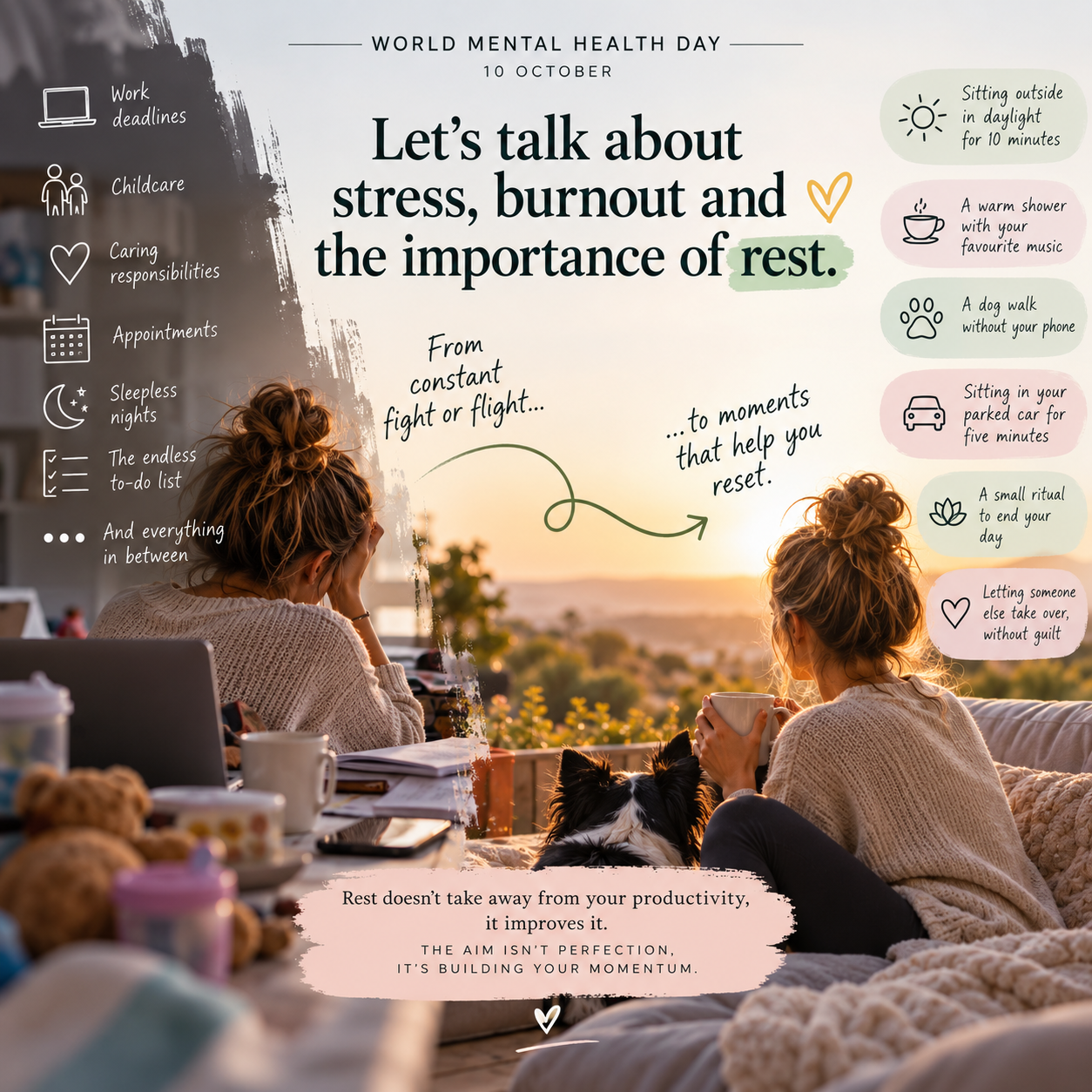
Work. Childcare. Caring responsibilities. Appointments. Deadlines. Sleepless nights. The mental load that continues long after the working day has finished. For some of us, responsibilities don’t stop at 5pm. Sometimes they don’t stop overnight. And when you don’t have much support around you, you become incredibly good at adapting.
You push through. I became very good at pushing through. I’ve also experienced burnout more than once.
Only recently have I started consciously prioritising my own health and wellbeing. Not because life has suddenly become less demanding, but because I want to be physically and emotionally present for my family for many years to come.
And that has made me reconsider what resilience actually means.
When constantly coping becomes normal
When we live with ongoing pressure, it can become difficult to recognise how stressed we actually are.
Being busy becomes normal. Feeling tired becomes normal. Constantly thinking about the next thing becomes normal.
We can become so focused on looking after everyone and everything else that somewhere along the way, we stop paying attention to ourselves.
Recently, I’ve developed a real passion for understanding our nervous system and the way our bodies respond to stress.
Our fight-or-flight response is one of the body’s built-in survival systems. When our brain senses danger or pressure, the sympathetic nervous system helps prepare us to respond. Our heart rate can increase, our breathing can become faster, our muscles tense, and stress hormones such as adrenaline and cortisol help mobilise energy.
In simple terms, our body shifts into “something needs my attention and I need to deal with it” mode.
That response is incredibly useful when we need it. The difficulty is that our nervous system doesn’t only respond to physical danger. Work pressure, an endless to-do list, worrying about our children, caring responsibilities, lack of sleep and constantly anticipating what needs to happen next can all contribute to our stress response.
When those pressures keep coming, we can find ourselves spending far too much time in a heightened state of alertness.
For me, that doesn’t necessarily look like panic.
It can look like constantly thinking three steps ahead. Struggling to sit still when there is finally nothing urgent to do. Reaching for my phone. Finding another job that needs doing. Feeling guilty for stopping. Or being physically exhausted while my mind is still racing.
I had become so used to being “on” that being “off” started to feel uncomfortable.
Learning to recognise these patterns has completely changed the way I think about rest.
I’m beginning to understand that rest isn’t simply doing nothing. It is giving my mind and body opportunities to come down from that state of alertness, recover and prepare for whatever comes next.
Rest is part of resilience
One of my biggest learnings has been surprisingly simple:
Rest isn’t the opposite of resilience. Rest is part of resilience.
Our bodies need opportunities to recover from periods of stress. That doesn’t mean we can somehow breathe our way out of an impossible workload, caring responsibilities or a lack of practical support. But small periods of recovery still matter.
We often make self-care far more complicated than it needs to be. It doesn’t have to mean a weekend away, a spa day or escaping family life.
For me, it can look like taking the dog for a walk without filling the silence with a podcast or audiobook.
It can mean sitting outside in daylight for ten minutes.
Having a warm shower while listening to music.
Drinking a cup of tea without simultaneously answering emails.
Sitting in the car for five minutes before walking back into the house.
Or allowing somebody else to take something over without immediately finding another job to do.
The activity itself isn’t really the point.
What matters is how it makes you feel.
Does your breathing slow down? Do your shoulders drop? Does your mind become quieter? Do you feel more present? Do you feel less as though you need to be somewhere else or doing something else?
That is something I’m learning to pay much more attention to.
What I’m beginning to notice
Perhaps the biggest change isn’t what I do to rest. It’s what I’m beginning to notice in the moments when life is anything but restful.
The stressful situations haven’t disappeared. My responsibilities haven’t reduced.
My daughter still wakes most nights, often in the early hours, and the morning still comes around far too quickly afterwards.
But my response is beginning to change.
When I wake in the middle of the night, I’m increasingly able to meet that moment with calm rather than immediately feeling frustrated about the sleep I’m losing.
That may sound like a small change. For me, it isn’t.
Our mornings can also be incredibly demanding. Two children to get ready, everything that needs to happen before we leave the house, work waiting, and inevitably something unexpected thrown into the mix.
Previously, one thing going wrong could make it feel as though the whole morning was beginning to unravel. Now, I’m noticing that things seem to fall into place more calmly, almost like pieces of a puzzle.
Not because everything suddenly goes to plan.
Because I’m becoming better able to stay grounded when it doesn’t.
And perhaps the change I value most is what happens when my children are struggling.
When both girls are overwhelmed or having meltdowns at the same time, their emotions naturally create pressure in me too. I’m increasingly able to recognise that response in my own body and regulate myself before reacting to it.
Because when my children cannot find their calm, they need me to hold mine.
This is co-regulation in everyday life. Children often rely on a calm, responsive adult to help them manage big emotions and move towards a more settled state. I cannot remove every difficult emotion or prevent every meltdown, nor would that be the aim.
What I can do is become more aware of what I bring into those moments.
And I can see the difference.
For me, this is where everything I have been learning about rest, recovery and nervous-system regulation comes back to resilience.
The stressful moment still happens. The difference is how I meet it.
I’m not writing this as someone who has mastered any of this. I still have moments when I become frustrated, overwhelmed or exhausted. I’m human.
The aim isn’t perfection.
It’s building momentum and awareness.
Every time I recognise that I’m becoming overwhelmed, create space to recover, or respond more calmly than I might have done before, I’m practising something I want to become more natural over time.
And I’m beginning to understand that taking care of myself isn’t separate from taking care of my family.
It is part of it.