
Uniforms, Meltdowns and a Very Badly Timed Sickness: Building Resilience, One Step at a Time
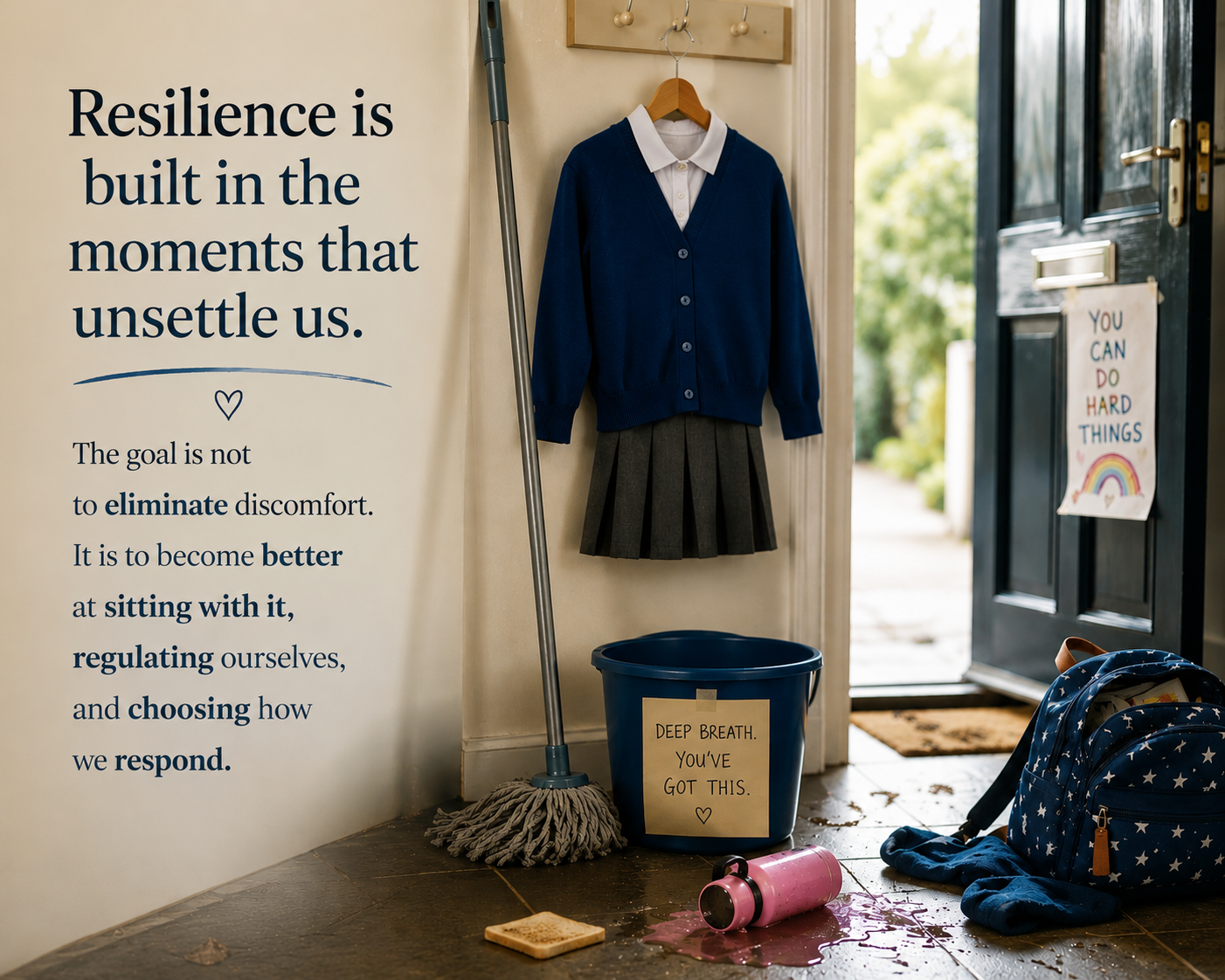
There is something about the first morning back at school that makes you believe preparation will save you.
After a whole summer of slower mornings, later starts and considerably more flexible routines, I knew getting two little girls up, dressed, fed and out of the house on time was going to be a bit of an adjustment. So I did what I could to make life easier for us. Uniforms were ready, bags were packed, water bottles were sorted and everything that could reasonably be prepared the night before had been done.
I went to bed feeling quite pleased with myself. We were ready.
Or so I thought.
Domi had a great night's sleep and woke up at exactly the right time, so we were off to a surprisingly good start. Margaux had a slightly more challenging morning and needed a little more encouragement to embrace the idea that summer mornings were over, but nothing we couldn't handle.
At 6am, I looked at the clock and thought we had loads of time.
What felt like seven minutes later, turned out to be nearly 7am.
I genuinely don't understand what happens to time on school mornings. There seems to be some sort of parental time warp where you begin the morning calmly drinking a coffee and suddenly find yourself wondering why nobody has any trousers on and you need to leave in ten minutes.
Still, this was exactly why I had prepared. We had a plan. We were going to be fine.
Then I started getting Domi into her uniform.
The uniform that had fitted her before the summer was suddenly far too tight. Apparently, alongside everything else we had done over the holidays, she had quietly decided to grow at an extraordinary rate.
So the uniform had to come back off.
For many children, this might be a small inconvenience. For Domi, who has sensory processing difficulties, getting dressed can already take quite a lot from her. She had gone through the process of getting ready, only for us to suddenly change what was happening, take everything off and start again.
Unsurprisingly, she was not impressed.
What followed was a meltdown, a change of clothes and a rapidly moving clock. The calm, organised morning I had imagined was disappearing in front of me.
Eventually, though, we got there. Both girls were dressed. Shoes were on. Bags were packed. Water bottles were ready. We were ready. We were actually standing by the front door.
There is a very specific sense of achievement that comes with getting two small children completely ready and within touching distance of the outside world on a school morning. For one glorious moment, I genuinely thought we had done it.
And then Margaux was sick. Right by the front door.
Of course she was.
Standing there, looking at the latest development in our beautifully planned first morning back, I realised there really wasn't anything else I could have done to prepare for it.
And strangely, that thought helped.
I had prepared everything I could prepare. What I couldn't prepare was the people.
I couldn't control how much Domi had grown over the summer. I couldn't control how her nervous system would respond to the unexpected change. I couldn't control Margaux being sick at precisely the moment we needed to leave. And I certainly couldn't control whatever strange phenomenon had caused 6am to become 7am in what appeared to be a matter of minutes.
What I could control was what I did next.
And that is where our slightly chaotic first morning back became a very ordinary reminder of something I think about a lot in my work as a resilience coach.
We often think resilience is about coping well. Staying calm. Being organised. Keeping everything together when life becomes difficult. But is that really what resilience looks like, particularly in everyday family life?
Sometimes resilience starts with recognising that things are not going according to plan and asking yourself a very simple question:
This is not going how I planned. What does this moment need from me now?
When things start going wrong and the clock is ticking, it is incredibly easy for our own stress to take over.
“Come on, we need to go.”
“Quickly.”
“Where are your shoes?”
“We're going to be late.”
I have said all of them in the past.
The trouble is that telling an overwhelmed young child that we are going to be late rarely produces the burst of efficiency we are hoping for. If anything, our stress can quickly become their stress, and suddenly everyone is finding the morning harder.
With more than one child, there is another layer to it. It isn't simply twice as many shoes to find or twice as many people to dress. You are dealing with different little people who may need completely different things from you at exactly the same moment.
One might be excited about going back while another feels overwhelmed. One needs you to hurry while another desperately needs you to slow down. One needs practical help while another needs reassurance. All the while, you are watching the clock, thinking about where everyone needs to be and trying to manage your own response.
That, to me, is where resilience becomes very real.
It isn't remaining perfectly calm while one child is having a meltdown and the other has been sick on the doorstep. It isn't smiling serenely through the chaos or pretending that you aren't stressed.
It is noticing what is happening inside you before that stress takes over the whole room. It is deciding what actually matters in that moment and letting some of the other things go.
Sometimes that means accepting you are going to be late. Sometimes it means abandoning something you had planned to do that morning. Sometimes it means stopping everything for a cuddle. Sometimes it means laughing because the situation has become so spectacularly far removed from the morning you imagined that laughter is about the most useful thing you have left.
And sometimes, despite knowing all of this, you will still lose your patience. You might snap. You might raise your voice. You might handle a moment differently from how you wish you had.
Resilience isn't getting every response right either. It is recognising when you haven't, repairing it and starting again.
We can put quite a lot of pressure on ourselves around the start of a new school year. There are fresh uniforms, first-day photographs, new routines and the feeling that we should somehow have everything together. Yet our children have spent weeks living to a completely different rhythm. They have slept later, had less structure and become used to mornings that don't necessarily involve being somewhere at an exact time.
September arrives and we expect the whole family to switch overnight.
Perhaps those first few mornings aren't supposed to be seamless. Perhaps they are simply what transitions look like.
Some children will bounce through the school gates without looking back. Others will need a little longer. Some mornings will run beautifully and others will involve tears, missing shoes, untouched breakfasts, raised voices or an unexpected change that throws everything off course.
And apparently, occasionally there will be unexpected sickness.
Our first morning back wasn't the calm, organised morning I had prepared for. But everyone was OK. The girls got where they needed to be. The too-small uniform could be replaced. The floor could be cleaned. And the following morning, we got another chance.
That is perhaps what I want to remember most from our first day back.
Resilience isn't about becoming so organised that difficult moments stop happening. Preparation helps, routines help and planning ahead absolutely helps, but none of them give us control over everything that is going to happen.
Resilience is what we do when, despite all that preparation, life refuses to follow the plan.
We adjust. We recover. We learn what we need for next time.
And then we try again tomorrow.
Preferably with a uniform that actually fits.